
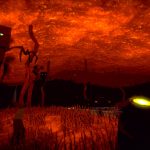



Solo developer Shady Trail released the announcement trailer for Eigenstate, a telescope operation game where scientific observation gives way to cosmic horror. Eigenstate arrives on Steam in Q4 2026, with a free demo coming in September.
About the Game
Eigenstate casts players as an astronomer arriving at Cerro Seco National Observatory, a research facility on a mountaintop above the empty desert of southern Arizona. The expected research advisor and technical staff are nowhere to be found, and the observatory itself sits powered down and in disrepair.
Players begin their research alone. They’ll slew the telescope across a vast night sky, lock on to distant objects, and hold the instrument steady while data comes in, working against strict nightly limits on power and storage. Raw captures aren’t enough: players analyze each observation through signal-processing minigames before adding it to their catalogue. That data unlocks improvements across the mountaintop, bringing new instruments online to observe additional spectra, resolve fainter objects, and reach parts of the sky that were previously inaccessible.
As instruments improve, the sky resolves more clearly, and so does something hidden within it. The telescope begins to move on its own. Unexplained data accumulates on the servers. Interference bleeds between systems. The better the equipment gets, the more clearly the anomaly can be seen, and the more it appears the vanished staff detected it first.
Eigenstate takes its name from quantum mechanics: the state a system is left in once a measurement forces it to settle on one definite answer. Here, the measuring is the gameplay, but players will discover something that doesn’t just get measured but reacts to being observed.
“It started as an observatory sim with a progression system,” says Chris Pepe, the sole developer behind Shady Trail. “I wanted the progression itself to become the threat.”
The setting traces back to a high school visit to Kitt Peak National Observatory in southern Arizona. “I remember the feeling of isolation at different levels: at the top of a mountain in the middle of the desert, in a giant dome filled with huge machines, and on a tiny planet looking out into space,” Pepe says. “That’s the mood that I started from with Eigenstate.”
Features
- Two phases, one rhythm: Nights at the telescope, evenings on foot. Walk the mountaintop in first person between sessions: bring dead systems back online, install upgrades at the console or out at the hardware itself, and find your way into buildings that start the game locked.
- The instrument fights you: Holding the scope on target is a live tracking skill, not a button hold. Some objects carry hazards that punish a wandering hand or change the rules partway through a capture – and once something out there starts interfering, your controls drift, invert, and lie to you.
- Fill the catalogue: Over 850 astronomical objects spanning more than 20 classes: main-sequence stars, pulsars, molecular clouds, and others. The sky catalogue fills in as you work, illustrated with plates of the specimens you caught yourself. Exotic objects drift through unannounced then are gone again, so catch them while they last.
- Different sensors, different sky: The same object gives up different data in visible, infrared and ultraviolet light. Analyze each spectrum differently: frame a peak in a sliding window, chase a live signal through a moving aperture, or fit a rotating band to a scatter of points. In every case, you’re racing to capture the signal before it’s gone.
- Reconstruct the disappearance: Every restored computer and reopened building reveals another piece of what happened to the observatory staff.

